Inksights Blog : The Reputation Ink Blog
Media Exclusives: How and When to Use Them

By Reputation Ink
2.10.26
In many newsrooms, one of the first questions a news director asks after hearing a compelling story idea is, “Is it exclusive?”
The goal is simple: determine whether the outlet can be the only source of the story or at least the first to break it. In an environment where audiences have constant access to information, media outlets are always looking for ways to stand out from competitors.
For PR purposes, exclusives can help you squeeze all of the “juice” you can get out of a story and make sure it’s placed with an outlet that will give it the coverage you think it deserves.
In today’s fragmented media environment, exclusives can also help cut through the noise. When used strategically, they don’t just secure coverage, they create focus, deepen storytelling and strengthen relationships with the media outlets that matter most.
What are exclusives?
Depending on who you talk to, the exact definition of an exclusive varies.
The most common form of an exclusive is when a source gives a journalist or outlet an offer to be the first to publish a story before making it available for other outlets to cover.
Others consider exclusives to be stories offered to and published in only one outlet.
Depending on the story, exclusives can get different treatment. Sometimes interviews with a key figure or juicy tidbits of information are offered as exclusives — it all depends on the terms agreed upon by both parties (we’ll get to that in a moment).
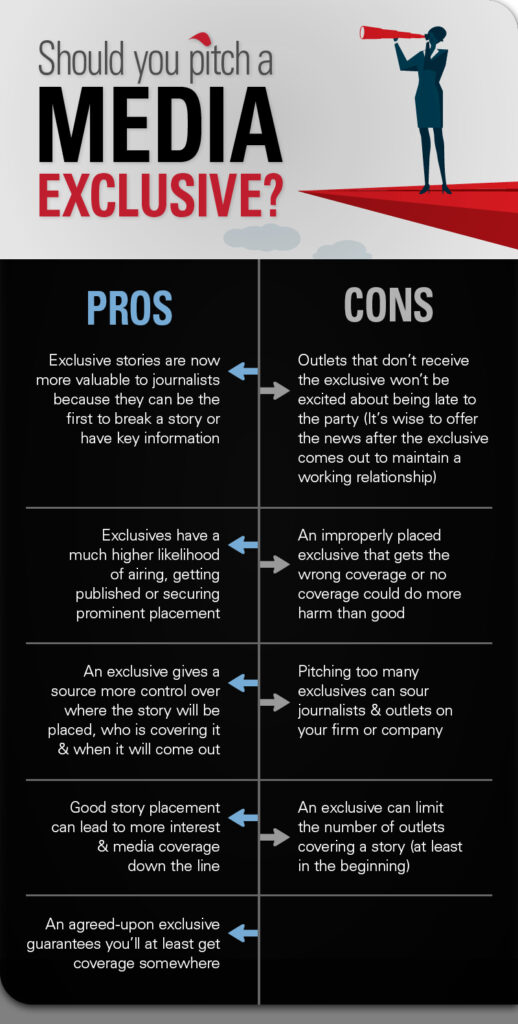
What should you pitch as an exclusive? It must be something truly newsworthy. No journalist worthy of the name will bite if you offer them an exclusive on a story that isn’t newsworthy. Maybe you are making a significant new hire or acquisition that will turn heads. It could also be the launch of a new service area or product. Whatever the specifics, exclusives are for something really big.
When NOT to use an exclusive
Exclusives can be powerful, but they’re not always the right approach.
- Routine announcements: Not every piece of news warrants exclusivity. Routine hires, minor updates or incremental changes are often better suited for broader distribution.
- When you need reach over depth: If your priority is wide visibility across multiple outlets, a press release or multi-outlet pitch may be more effective.
- When timing is critical: Exclusives require patience. If you need immediate coverage, waiting on a single outlet can slow momentum.
The key is alignment: exclusives are best used when the story benefits from depth, not just distribution.
how to Pitch an Exclusive
- Do your research. Make sure you pitch to a journalist who actually covers your industry and can do your news justice. Look for similar stories that have handled the topic the way you want your exclusive covered and make a list of potential journalists to contact.
- Reach out. Some newsrooms list staff email addresses on their websites, and others don’t mind being contacted via online platforms like X — but navigating this territory can be intimidating and time-consuming. (Partnering with a public relations agency that has established media relationships and resources can be more efficient. Wink.)
- Pitch one outlet at a time. Plan to give editors/producers a few days to accept or reject your pitch before sending it elsewhere. You don’t want two different outlets interested in the same exclusive at the same time — that could damage your credibility with both. Be clear when you send the exclusive pitch that there is a deadline for them to get back to you, or you’ll move on.
- Write the headline for them. When you send your pitch, write your subject line like it’s the headline of the story. Try to give them the “meat and potatoes” of the pitch in as few words as possible.
- Clearly communicate that the information is confidential until terms are agreed upon. The last thing you want to do is waste an opportunity to make your story go as far as possible by giving the outlet too much information outright.
Done well, exclusives don’t just secure coverage, they build trust with journalists who value access to thoughtful, well-developed stories.
Tip: Check out our post on newsroom roles to maximize every pitch.
Stipulations and best practices
- Tell everyone involved in the story (leadership, clients, partners, etc.) that you are pitching an exclusive to make sure they don’t let the story slip before publication.
- Your media contact might not be able to tell you exactly when it will air or publish early on, but you should have a rough idea of what to expect before agreeing to go with a certain outlet.
- Find out what angle they’ll be taking and the kind of coverage you can expect: where your news will be featured, what day or time-slot in which it will be published and how long of a story it will be.
- Your newsroom contact will likely ask if a press release will follow their story or if other outlets will receive the info by a certain date. Have a goal in mind, but be flexible if it aids negotiation in your favor.
- Remember, exclusives aren’t legally negotiated agreements. An exclusive is a deal of good faith between both parties to uphold the conditions of the agreement. Failing to uphold your side of the deal will hurt your reputation and could ruin your chances of working with that media outlet in the future.

Related B2B Content

How High-quality Content Helped Instructure Increase Lead Generation in a New Market
Reputation Ink | Mar. 7, 2025

Positioning a New Energy Company and Helping It Grow With Quality Content and PR
Reputation Ink | Oct. 7, 2024

How Strategic Positioning Helped Trutechnology Communicate Its Unique Value
Reputation Ink | Sep. 7, 2024